
Organic Farming
What happens when soil comes back to life?
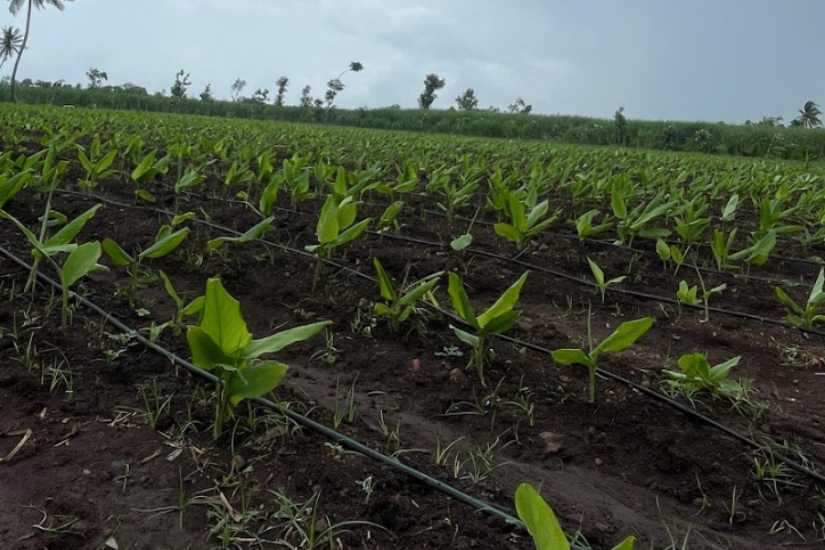
The science, economics, and common sense behind organic agriculture from farmers and agronomists who made the switch.
There is a question that rarely gets asked in conversations about organic farming: What is actually happening inside the soil?
Because when you understand that, the rest of the argument – for or against – starts to look different. The economics shift. The timelines make sense. And the quality of what grows in that soil starts to tell its own story.
We spend a lot of time listening to farmers, agronomists, and practitioners across India. People who have transitioned from chemical to organic farming because the math stopped working for conventional farming. Some were losing money. Some watched their soil turn to dust. Some started asking hard questions about what was ending up in the water and the food.
What follows is drawn from those conversations. It is what they saw, measured, and lived through not theory.
The 97% that farming forgot
Agriculture 101 A plant’s total biomass (everything it produces) is made up of roughly 95–97% carbon, hydrogen, and oxygen. These come from air, water, and sunlight through photosynthesis. The remaining 1.5–2% is minerals. That is the ash you’d find if you burned the plant.
The entire fertilizer industry is built around that 1.5–2%.
It is basic plant biology. The equation is straightforward: CO₂ + water + sunlight = carbohydrates. The plant manufactures its own bulk from what’s freely available around it.
The practical implication is enormous. A farmer’s primary job is not to feed the plant minerals. It is to create the conditions where photosynthesis works well, including healthy leaves, good light interception, adequate water, and a soil biology that handles the mineral part on its own.
But that’s not what most farmers are taught. They are sold fertilizers at a subsidy and taught fertilizer schedules.
How the soil works
Healthy soil is a living system made of billions of bacteria, fungi, and microorganisms in every handful of dirt that performs a specific job: making nutrients available to plants.
Here is the loop, simplified:
A photosynthetically active plant sends roughly 50% of the sugars it produces back down through its roots as liquid carbon. These are called root exudates. They are the primary food source for soil microbes. In return, those microbes break down minerals already present in the soil and deliver them to the plant in forms it can absorb.
This is the deal. The plant feeds the microbes. The microbes feed the plant. It has worked this way for hundreds of millions of years. When this system is intact, the soil does most of the work. The farmer’s role is to support the system, not replace it.
One farmer put it simply: “The farmer doesn’t feed the plant. The farmer feeds the soil, and the soil feeds the plant.”
What chemical inputs do to this system
Synthetic urea or nitrogen fertilizer (the most widely used input in conventional farming) does something specific and measurable to soil biology. Added nitrogen fuels a microbial “priming effect,” where bacteria rapidly consume soil organic carbon for growth, releasing CO2 and temporarily lowering organic carbon stocks.
This boosts bacterial populations but can suppress fungi and overall diversity, slowing nutrient cycling if over-applied; plants access native soil nutrients less efficiently without balanced biology, though optimized N enhances yields without full dependency.
Without microbes, nutrients already present in the soil become inaccessible — locked in chemical forms that plants can’t use. The plant, now cut off from its natural nutrient pipeline, becomes dependent on external fertilizer to survive (Ullah et al., 2023).
The soil is, in a real sense, addicted.
This is why a conventional farmer can’t simply stop applying fertilizer and expect things to be fine. The biology is gone. The soil has lost its ability to function on its own. It needs to be deliberately rebuilt.
And it gets worse. The dependency creates a cascade:
Synthetic fertilizer burns organic carbon. The microbiome collapses. Without microbes, the plant weakens. Weak plants attract insects — they are biologically programmed to attack struggling plants. So now you need pesticides. Pesticides kill remaining soil microbes, making the soil even more dependent. Weeds proliferate in degraded soil, so herbicides follow. Mineral salt buildup from fertilizers hardens the soil structure. Heavier tractors are needed. The tractors compact the soil further, reducing air and water movement. Each input creates the need for the next. This is a ‘slippery slope fallacy’ but you get the picture.
An agronomist we listen to, who spent 30 years in commercial farming across India, Kenya, and Europe, described it bluntly: “Herbicide kills herbs. Fungicide kills fungus. Insecticide kills insects. What is synthetic fertilizer? It is an ecosystem killer. That is the name it deserves.”
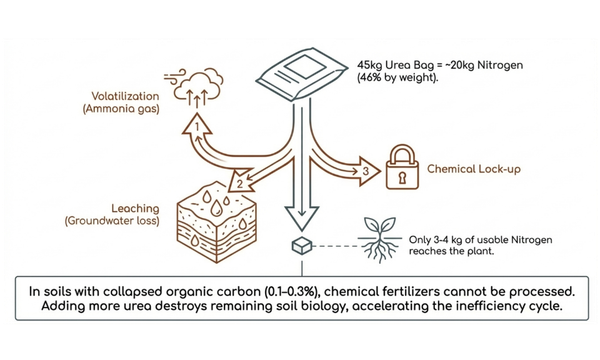
Consider the economics of just one input: urea. A 45 kg bag contains about 46% nitrogen – roughly 20 kg. But in degraded soil with low biological activity, the plant receives only 3–4 kg of usable nitrogen from that bag. The rest volatilizes into air, leaches into groundwater, or binds into forms the plant can’t access. The farmer pays for the full bag. The plant gets a fraction.
Meanwhile, a single application of Azotobacter — a naturally occurring soil bacterium — can fix 15–20 kg of atmospheric nitrogen per acre per season, at a fraction of the cost.
The math is not subtle.
What organic methods restore
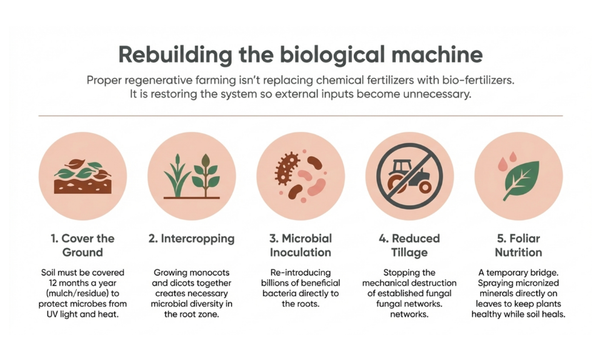
Organic farming, done properly, is not about swapping one set of products for another. It is not about replacing chemical fertilizer with bio-fertilizer and calling it a day. That is the same structural dependency with a different label. Proper or regenerative organic farming restores the biological system that makes external inputs unnecessary.
The practitioners we’ve listen to share a set of principles. None of these require expensive technology. Most require changing a habit more than spending money.
- Cover the ground. This is the single most important instruction, and the one most directly contradicted by conventional agronomy training. Soil must be covered 12 months a year, with crop residue, mulch, or a living cover crop. Bare soil in direct sunlight reaches temperatures that kill surface microbes. Covered soil maintains stable temperature and moisture — the conditions microbial life needs. As mulch breaks down, it feeds the soil food web from above. The crop residue that farmers in Punjab burn every year? That is not waste. It is soil food.
- Intercropping and rotation. Growing two or more crop types together — alternating monocots and dicots, different root depths, different nutrient demands — creates microbial diversity in the root zone. Crop rotation between seasons prevents the pest and disease buildup that monoculture enables. One farmer in Kenya, growing 250 acres of vegetables with crop rotation as his sole focus, has watched his soil improve every year with minimal other intervention. His spray costs have dropped steadily.
- Microbial inoculation. Where animal integration is possible, dung and urine from native cattle breeds provide the most diverse microbial consortium available. A single desi cow can support 30 acres of farmland through Jeevamrit — a simple fermented preparation made from cow dung, cow urine, jaggery, gram flour, and a handful of soil from under an old tree. Mixed in water, fermented for 48 hours, applied through irrigation. It costs almost nothing. It delivers billions of beneficial microbes directly to the root zone.
The science behind it is not mysterious. The jaggery feeds bacteria, causing rapid multiplication. The dung introduces diverse beneficial species. The urine provides micronutrients and natural plant hormones. The old-tree soil contributes fungi and native organisms suited to local conditions. - No-till or reduced tillage. Tilling — turning the soil before planting — is a chemical farming artifact. In natural systems, soil structure develops over years. Tilling destroys it. It breaks apart the microbial networks, exposes soil microbes to air and UV light, and resets the biological communities that took years to form. Farms that have practiced no-till for a decade report soil that holds itself, supports plant growth without mechanical disturbance, and absorbs water almost instantly — no pooling, no runoff.
- Foliar nutrition during transition. While the soil recovers — which takes time — plants still need feeding. Foliar sprays of micronized minerals (calcium, phosphorus, micronutrients) delivered directly to leaves bypass the broken soil system temporarily. As soil biology recovers, the need for foliar feeding decreases. This is an important bridge: it keeps the plant healthy while the real recovery happens underground.
The economics - the numbers
This is where most people’s skepticism lives, and it’s fair. Farming is a livelihood. Nobody can afford to run a philosophy experiment on their income.
So here are the numbers, as reported by farmers who tracked their costs through the transition.
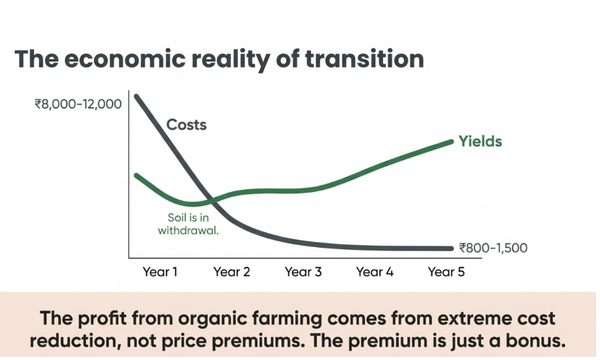
- Conventional input cost: ₹8,000–12,000 per crop cycle per bigha (roughly 0.25 acres).
- Organic input cost (year 4 and beyond): ₹800–1,500 per crop cycle per bigha.
That is an 80–90% reduction in input costs.
The profit from organic farming comes primarily from this cost reduction — not from the price premium. Even if a farmer sells at the same price as conventional produce, the math improves dramatically. The premium, where it exists, is a bonus.
But the transition is not free. And pretending otherwise would be dishonest.
- Year 1–2: Yields drop. This is normal and expected. Soil that has been chemically dependent for decades does not recover immediately. Input savings begin but don’t fully compensate. This is the hardest period.
- Year 3: Soil biology begins recovering. Yields stabilize. Input costs continue falling.
- Year 4–5: Yields may equal or exceed conventional yields. Input costs are a fraction of what they were.
- Year 5 and beyond: The soil becomes increasingly self-sustaining. Inputs continue to fall. Margins widen year on year.
The practical advice from every practitioner we’ve heard: don’t convert your entire farm at once. Start with one field, one crop. Prove the method works for your soil, your water, your climate. Keep one field chemical for income stability while transitioning another. This is not a leap of faith. It is a measured, field-by-field transition.
One farmer in Rajasthan described his journey as going from a 30% annual loss under chemical farming to a 300% gain under organic — not because his yields tripled, but because his costs dropped by 90% while he found ways to sell directly to consumers at fair prices.
What recovered soil produces
This is where the conversation connects to ingredient quality — and to why this matters for anyone sourcing herbs and botanicals.
Soil recovery is not abstract. It is measurable.
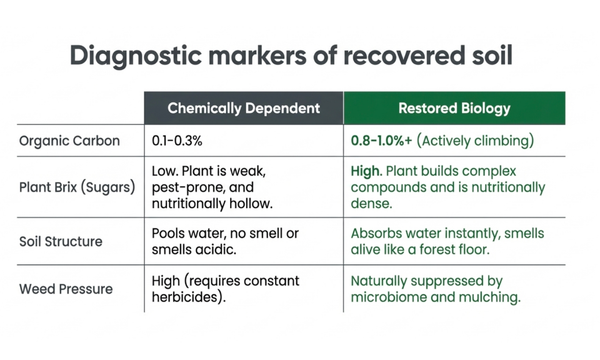
Organic carbon levels in degraded Indian soils often sit at 0.1–0.3%. Healthy soil should be 0.8–1.0% or higher. Farms in active organic recovery track this number annually and watch it climb.
Brix readings — a measure of sugar content in plant sap, taken with a simple refractometer — show the photosynthetic health of the plant in real time. High Brix means the plant is producing energy efficiently, building complex compounds, and is nutritionally dense. Low Brix plants are weak, pest-prone, and nutritionally hollow. Farmers who track Brix daily report a clear and consistent pattern: apply Jeevamrit or microbial inputs, Brix rises. Apply synthetic fertilizer, Brix drops — measurably, the very next morning.
Visual indicators tell the rest of the story. Soil that once pooled water for an entire day after rain now absorbs every drop instantly. Color shifts from dusty brown to rich dark brown. Healthy soil smells like a forest floor — alive, earthy, full of microbial activity. Degraded soil has no smell, or smells acidic.
Weed pressure drops. Not because of herbicides, but because a healthy soil microbiome and proper mulching suppress weed germination naturally.
What does this mean for the plant material that grows in recovered soil?
It means the herbs, the roots, the leaves that come out of biologically active soil have had access to the full spectrum of minerals — mobilized by microbes, not force-fed by synthetic salts. The photosynthetic activity is higher. The secondary metabolite production — the compounds that make herbs medicinally and functionally valuable — is driven by the plant’s own healthy biology, not compensated for by chemical intervention.
There is no shortcut to this. You cannot add a mineral and replicate what a functioning soil ecosystem produces. The complexity of microbial nutrient mobilization — dozens of bacterial and fungal species working in concert — produces a result that no synthetic formulation matches.
This is not a marketing claim. It is plant biology. And it is the reason soil health shows up in the quality of what grows.
What this means for the herbs you source
If you buy herbal ingredients (for teas, supplements, extracts, or formulations) the soil those herbs grew in is the single biggest variable in their quality. Not seed, not processing. The soil.
Herbs grown in biologically active, organically managed soil are working with a complete nutrient delivery system. Their roots are in conversation with a microbial community that has been rebuilding for years. Their photosynthetic capacity is high. Their secondary metabolite profiles reflect the full complexity of that biological relationship.
Herbs grown in chemically depleted soil are surviving on a drip feed of synthetic minerals. The biological conversation between root and microbe has been severed. The plant produces what it can under those conditions. But it is not the same plant.
At Herb Artizan, this is what sits behind our commitment to organic and regenerative sourcing. We don’t do it for the sake of the label it is a quality standard we believe in. It is how we understand the soil, plants, and the biology that connects them.
We have been working with farmers and farming communities for over 50 years. We have watched the difference that soil health makes in the field, in the lab, and in the final product. Our certifications (NOP, EU Organic, Fair for Life, Regenerative Organic, and others) reflect this commitment. But the commitment came first. The certifications followed.
We are still learning. Every farmer we listen to teaches us something. The practitioners whose observations shaped this article have spent decades, in their fields, testing, failing, adjusting, and proving what works. We are grateful for what they share. And we believe that the more the industry understands soil biology, the better the products and the supply chains become for everyone.
Written by Nikita Agarwal (PhD)
Food Science, with minors in Nutrition & Economics, Cornell University
Related Blogs
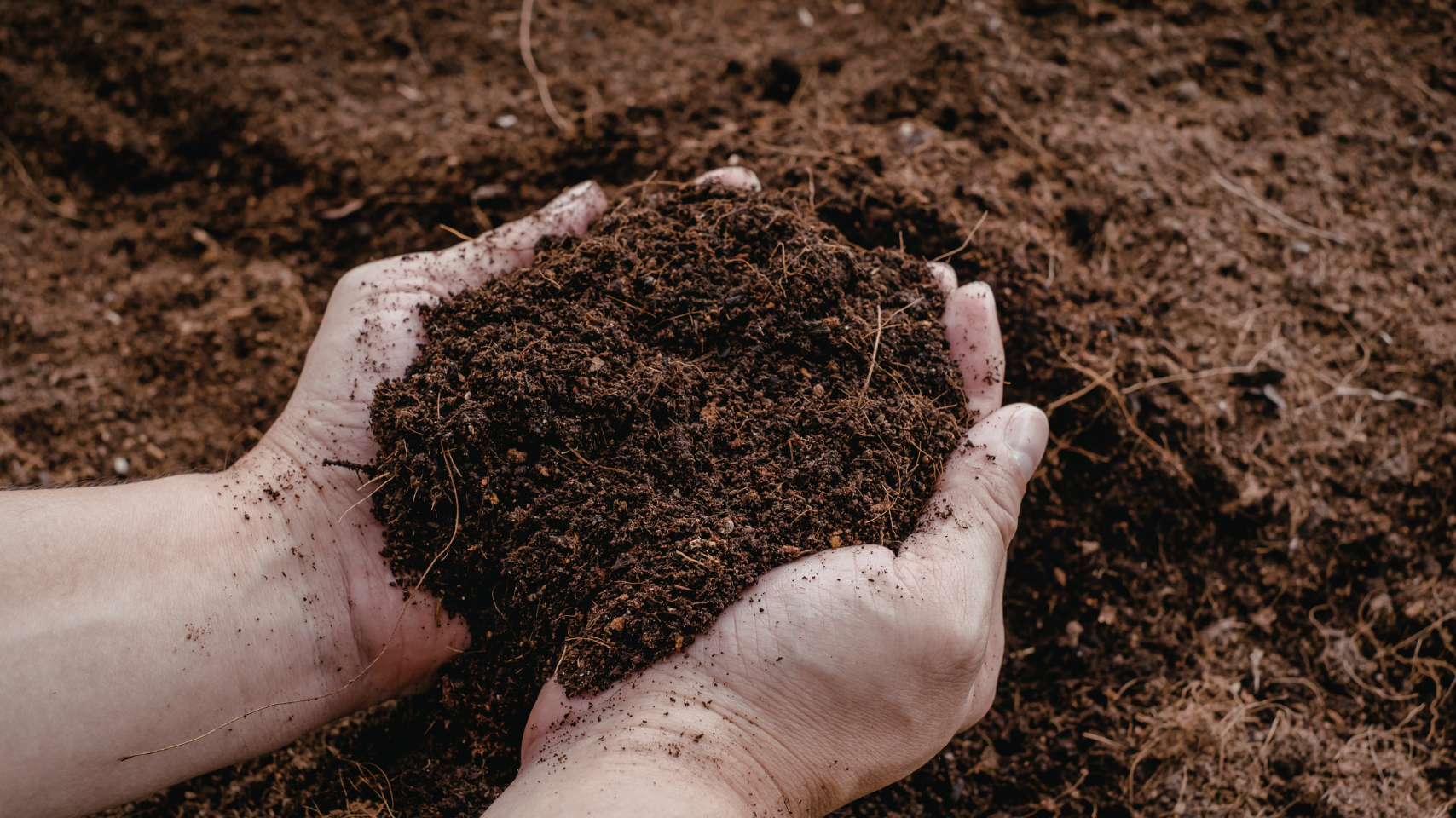
When the Soil comes back to Life
The science, economics, and common sense behind organic agriculture from farmers and agronomists who made the switch.
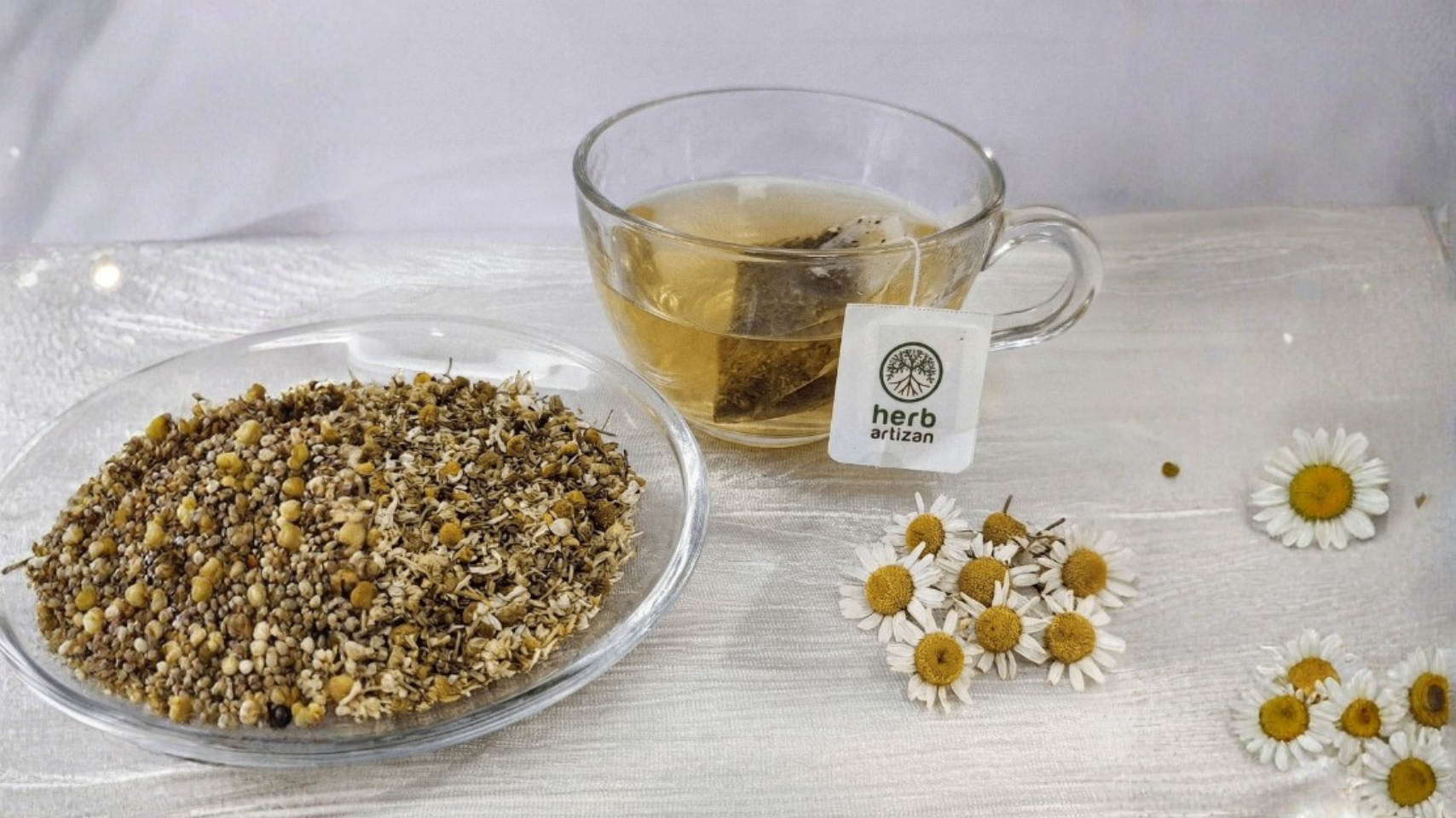
Chamomile Tea
The name “chamomile” has a fascinating origin that perfectly captures the essence of this beloved plant
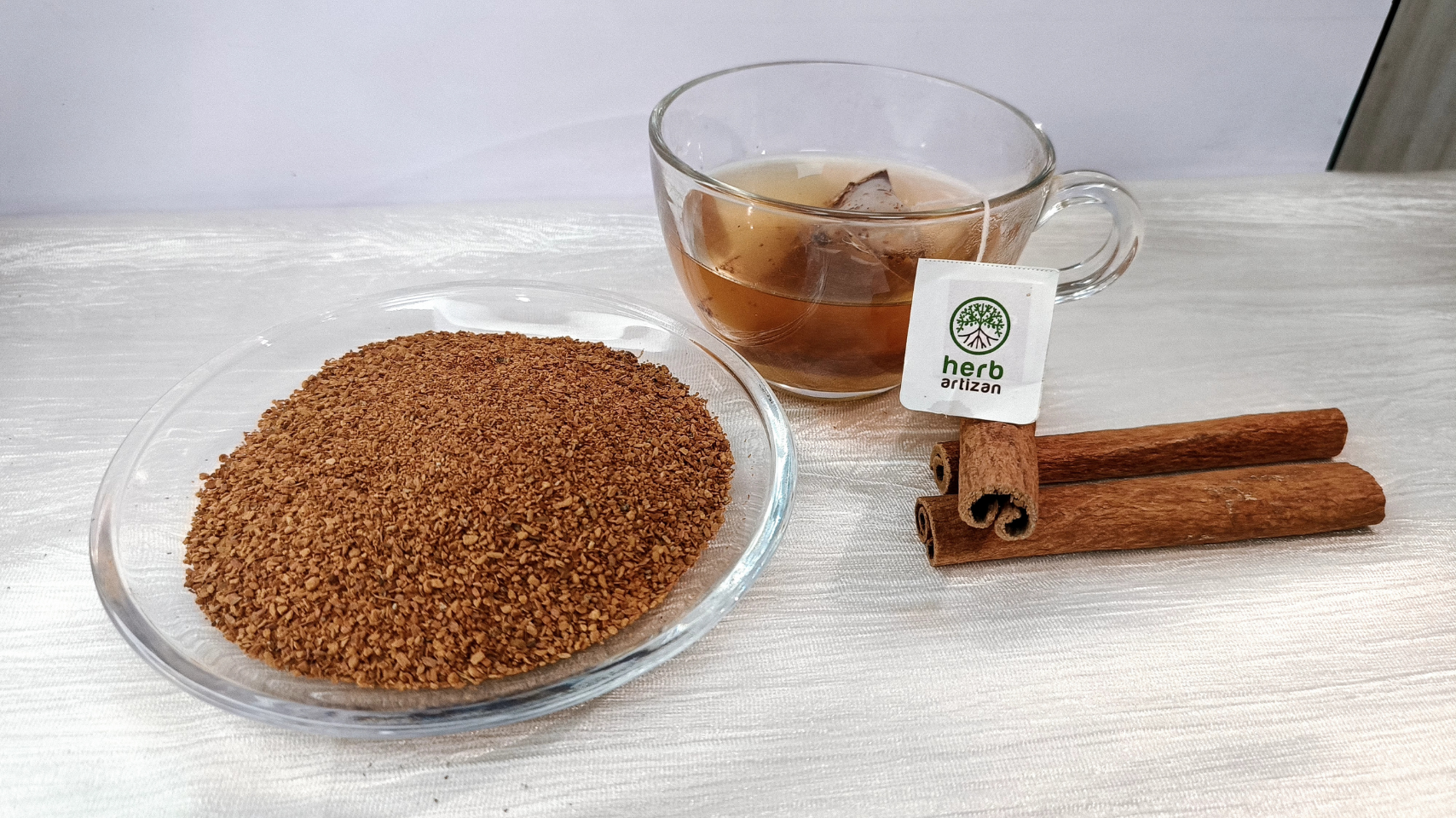
Cinnamon Tea
Cinnamon has a rich history dating back thousands of years. The name “cinnamon” is
When the Soil comes back to Life
The science, economics, and common sense behind organic agriculture from farmers and agronomists who made the switch.
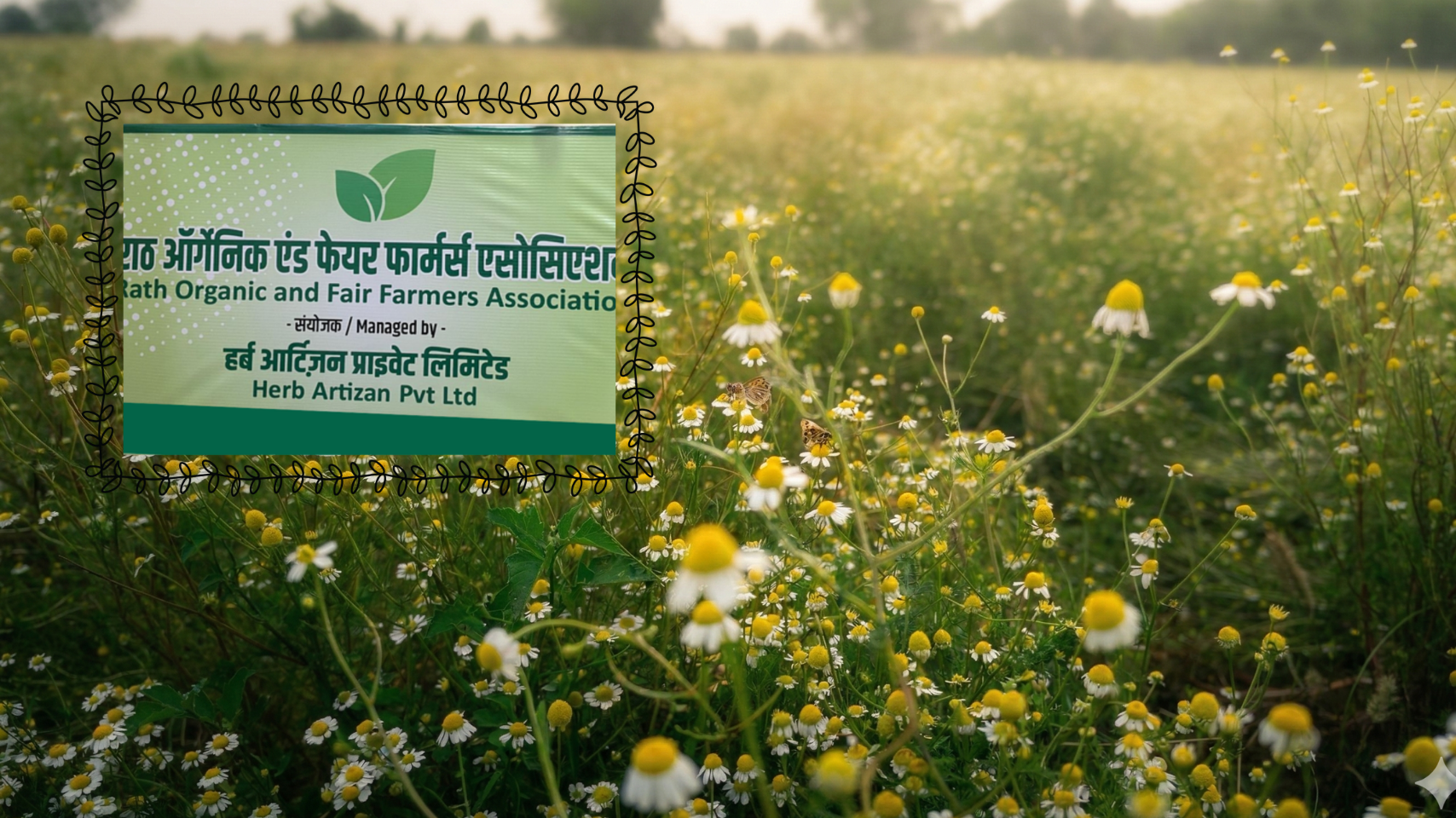
Our ICS group
The chamomile was spread out on white tarpaulins. Men and women turning it by hand in the
Chamomile Tea
The name “chamomile” has a fascinating origin that perfectly captures the essence of this beloved plant
Cinnamon Tea
Cinnamon has a rich history dating back thousands of years. The name “cinnamon” is